"Biodegradable Packaging Can't Perform Like Plastic" — Partly True, Mostly Outdated
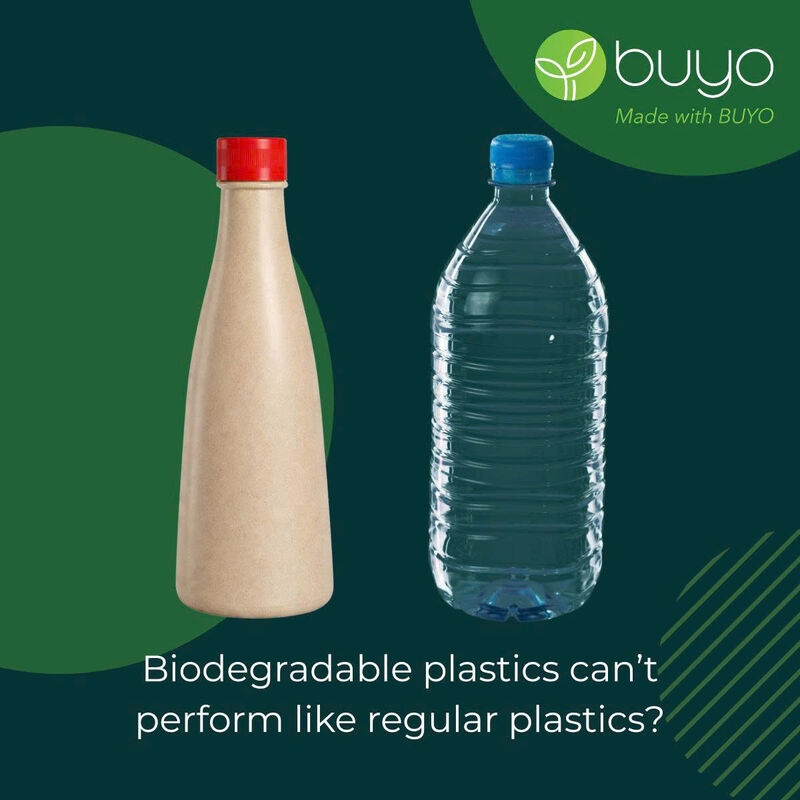
We hear this objection often. And the honest answer — the one we'd rather give than a sales pitch — is: it's partly true. A supplier who tells you biodegradable materials perform identically to conventional plastic in every application isn't being straight with you. The nuance matters, and it's worth understanding precisely.
Where the criticism has merit
Standard PLA softens above 60°C. In heat-intensive or heavy-duty applications — industrial packaging, high-temperature food processing, long-term outdoor use — standard polylactic acid has a genuine thermal limitation that conventional plastic does not. This is real, it matters for certain use cases, and any honest conversation about biodegradable materials has to start here.
Acknowledging this limitation isn't a concession. It's the foundation of a more useful conversation — because once you understand where the constraint is, you can evaluate whether it actually applies to your application. For most food service, packaging, and agricultural use cases, it doesn't.
Where the claim falls apart
Biodegradable materials science has advanced significantly. The category is no longer defined by the limitations of first-generation PLA. Today's engineered biodegradable materials are purpose-built for specific performance requirements — and in many applications, they match or exceed conventional plastic's functional profile.
Material by material
Standard PLA (polylactic acid)
Limited heat tolerance
Suitable for cold and ambient food packaging, cups, lids, and light-duty applications. Thermal limit: ~60°C — not suitable for hot food service without engineering modification. Genuine limitation in heat-intensive use cases.
CPLA (crystallised PLA)
Hot food ready
Engineered to handle temperatures up to 90–100°C — reliable for hot soups, noodles, and food service applications without deforming. The thermal limitation of standard PLA is addressed by the crystallisation process. Certified food-safe and fully biodegradable.
Bagasse (sugarcane fibre)
Pressure & heat resistant
Naturally heat-resistant, oil-resistant, and moisture-resistant. Holds structural integrity under pressure and temperature. Works well for hot food containers, plates, and trays where both rigidity and biodegradability are required. Not a compromise — a material engineered for the job.
The right question to ask
"Does this material match what I'm actually asking it to do?"
The biodegradable versus conventional framing is the wrong frame. It treats an entire category of materials as a monolith — which is as unhelpful as asking whether "plastic" or "metal" is better without specifying the application. The question that leads to a good decision is whether a specific material, with its specific performance characteristics, is suited to the specific demands of the use case.
In the majority of food service, packaging, and agricultural applications, the answer is yes. In some heat-intensive or heavy-duty industrial contexts, standard PLA is not the right choice — but CPLA or bagasse often is.
At BUYO, our job is to help businesses navigate these material choices — matching the right biodegradable solution to the right application so that performance and sustainability aren't a trade-off.
Unsure which biodegradable material fits your application?
BUYO helps businesses match the right material to the right job — performance first.